
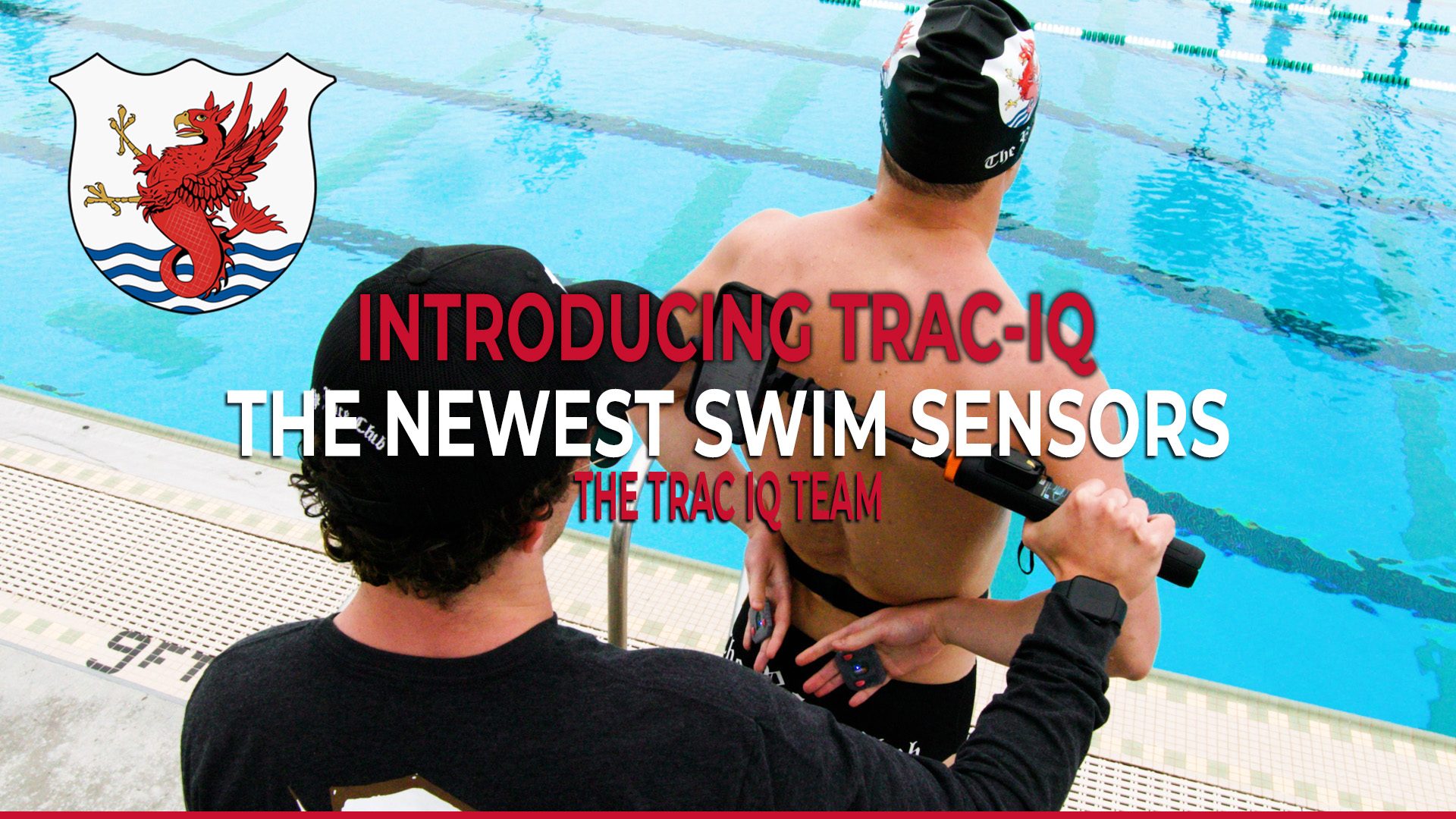

Today we are proud to introduce Trac IQ, the most complete look inside a swimmer’s stroke our sport has ever had. Built and powered by The Race Club, it pairs four wearable sensors with a companion app. As a result, swimmers and coaches can finally see what happens in the water, moments after it happens. For now, we are placing Trac IQ only with a select group of coaches.
Why We Built Trac IQ
Every coach knows the plateau. A hard working swimmer posts the same splits meet after meet, even though nothing in training has slipped. So the coach changes the sets, adds more effort, and tries every cue in the book. Still, nothing moves the needle.
We built Trac IQ around a different question. What if the problem is something no one can actually see? Often the answer lives inside a single phase of the stroke, far too fast for the eye or a stopwatch. Trac IQ finds it, measures it, and shows you how to fix it.
Four Sensors, One App
The hardware is simple by design. First, each hand wears a sensor built into a small paddle. Next, a third sensor sits on the lower back, secured with a belt. Finally, the fourth clips onto the goggle strap at the temple.
All four work together and record continuously. More importantly, Trac IQ tracks how each data point complements or interferes with the others. Because the sensors are small and unobtrusive, they also leave the swimmer’s natural technique alone.
2 Hand Paddle Sensors
First, they track hand entry, catch mechanics, and directional force production on every stroke.
1 Lower Back Sensor
Meanwhile, this sensor measures velocity, acceleration, and overall body alignment in the water.
1 Goggle Strap Sensor
Likewise, it follows head position, breathing cycles, and alignment from the temple.

What Makes Trac IQ Different
Smart paddles and velocity charts already exist, and many of them are good at telling you something is wrong. However, none tell as complete a story about drag and propulsion. Trac IQ tracks velocity, acceleration, and propulsive force frame by frame through the stroke, rather than averaging them over the length.
That distinction matters more than it sounds. After all, an average can look perfectly fine while a costly mistake repeats inside every single cycle. So Trac IQ couples hand forces with velocity and acceleration, phase by phase, then syncs that data to each frame of the swimmer’s video. Better still, it hands you the drills to fix what it finds.
Together, both hands, the lower back, and the temple record at the same time.
After testing, the coach uploads video and it syncs with the sensor data.
As a result, technique changes can happen in the middle of practice.
Instead, the whole test runs poolside with an iPhone and the sensor set.
What Trac IQ Found Inside Real Strokes
The best way to understand Trac IQ is to see what it catches. Each example below comes from a Race Club swimmer, and each error was invisible from the pool deck. In other words, these swimmers were working hard while their strokes quietly worked against them.
Freestyle: The Hidden Out-Sweep
Ideally, a freestyle stroke begins with as little out-sweep as possible. This swimmer, however, pulled sideways at 47 newtons as his stroke began. That was a quarter of his peak propulsion. Consequently, a large share of his effort went sideways when it could have driven him forward.

Freestyle: Pressing Up at the Finish
Another swimmer had a different problem. At the end of each pull, she pressed up on the water instead of back. In the app, the solid yellow line for vertical force climbs over the dotted yellow line. Meanwhile, the panel beside the video shows that same spike as a positive vertical force.

Rather than driving her forward, the last phase of every pull pushed her lower in the water. Nobody had ever mentioned it, because it was too subtle for the human eye. Once we knew, the fix was clear: extend the wrist and press back instead of up. After a week of the prescribed drills, we retested, and the up force number came right down.
Breaststroke: The Kick That Leaves Speed Behind
Trac IQ works on every stroke, and it measures drag just as clearly as propulsion. In this breaststroke test, the green velocity curve and the orange acceleration curve tell the story. Right after the first phase of her kick, her legs hang in the water. Combined with small streamline errors, that pause caps her speed.

Even so, a stopwatch would never catch it, because her average speed over the length looks fine. Ideally, K2 and K3, the smaller acceleration spikes, should stay positive. Instead, hers sit in the negatives on every cycle, so she loses crucial speed in a stop and go stroke.
Butterfly: Hanging Feet at the End of K1
In butterfly, the problem showed up right at the end of K1, the kick during the pull phase. Here the feet hang for an extra tenth, and the velocity curve drops sharply. Because the kick creates so much turbulence and happens so fast, no coach could see it from the deck. With Trac IQ, however, we can see it and measure it.

What looks like an impressive down kick is actually costing speed, since the hanging feet create frontal drag. Moreover, the app displays the exact deceleration synced to the frame, along with the velocity at that moment. This swimmer had no idea. In fact, they kept getting stronger and dropping time, yet still left far too much on the table.
“I learned more about my swimming after 10 minutes with Trac IQ than over years of training.”
First the Diagnosis, Then the Fix
Plenty of hardware can tell you what is wrong. Trac IQ also tells you what to do about it. Tap any metric, and the app pulls up a plain explanation with a short series of drill videos aimed at that exact error. As a result, coaches stop guessing what to do with a pile of complicated data.
Detect
First, the metric flags red the moment an error falls outside the effective range.
Diagnose
Then frame by frame velocity and acceleration show exactly where the stroke falls apart.
Prescribe
Finally, a detailed explanation and matched drill series target that specific error.
Every drill series is developed and tested by The Race Club, so it is never a generic tip. Instead, it is the actual fix, right there in the app. You see the problem, you get the fix, and you can retest the same day.
Red, Yellow, Green
Every metric scores instantly, so you can read the whole stroke at a glance. For example, peak propulsion, down forces, vertical forces, stroke rate, acceleration, and velocity all land on one testing page. Each one then carries a simple color.
Needs Work
Because it sits outside the effective range, this is the clear priority to fix.
Getting There
Although it is closer to ideal, improving it will still help performance.
Dialed In
In range, so this is exactly the color you want to see.
Coaches often ask how younger swimmers can make sense of this kind of data. The color system is our answer. With a coach beside them, even young athletes can understand the flaws in their stroke and watch the colors change as they improve.
Test Anywhere, Adjust Mid-Practice
Trac IQ runs wherever you swim. All you need is the app, the sensor set, an iPhone in a waterproof case, a measuring tape, and a selfie stick. That means no lab, no appointment, and no waiting.
Build the Profile
First, record palm length and width, arm length, height, and weight.
Connect the Sensors
Next, confirm all four over Bluetooth, and recording starts when the lights turn red.
Swim the Test
Then the swimmer completes the test while every sensor records continuously.
Sync on Deck
Afterward, the swimmer holds both hands behind the back while the data syncs to the phone.
Upload the Video
Finally, the coach uploads video, and it syncs with the sensor data in two to three minutes.
Because each test takes only minutes to analyze, we can make real technique changes in the middle of practice. Moreover, the app lets you compare multiple test results side by side. So you can see directly whether a change is helping or hurting, instead of guessing and hoping.
How Trac IQ Will Change the Swim World
For decades, coaches have relied on their eyes, a stopwatch, and the occasional lab visit. Those tools still matter. Still, the errors that hold swimmers back often live inside a single phase of a single stroke, far too fast to see.
Trac IQ changes that in three ways. First, it makes the invisible measurable across every stroke, not just freestyle. Second, it moves detailed stroke analysis out of the lab and onto any pool deck. Third, it closes the gap between diagnosis and correction, so every flagged problem arrives with its fix.
Ultimately, that means fewer mystery plateaus and more swimmers who know exactly why their speed is what it is. It also means coaches spend less time guessing and more time coaching. That is the future we are building, one stroke, one angle, and one force at a time.
Want to be one of the first coaches to use Trac IQ?
Right now, Trac IQ is not available to the public. Instead, we are giving it to a select group of coaches first. If you would like to be one of them, email our Trac IQ team and tell us about your program.
Swim Camps
First, spend four days training with our coaches and get a full stroke analysis.
Private Lessons
Meanwhile, one on one coaching targets your strokes, your turns, and your goals.
Gold Online Coaching
Likewise, our remote coaching gives you personal feedback on the video you send in.
